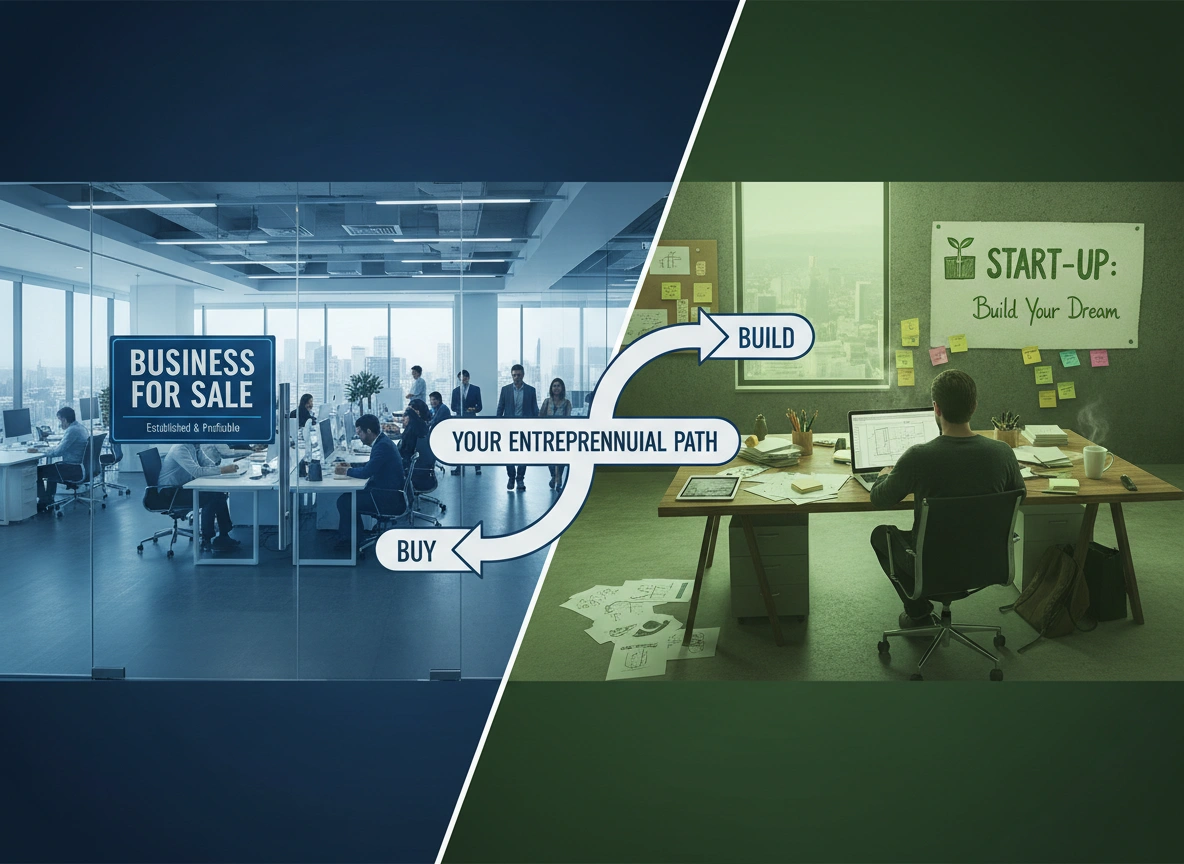
Entrepreneurship offers two primary entry points: building something entirely new or taking the reins of an existing operation. Both paths lead to business ownership, but the journeys look vastly different. One demands the grit of a creator, while the other requires the stewardship of a manager.
For aspiring entrepreneurs, this decision often triggers paralysis. Do you want the blank canvas of a startup, or the proven roadmap of an acquisition? Understanding the mechanics, risks, and rewards of each approach is the only way to make an informed choice that aligns with your skills, capital, and risk tolerance.
This guide breaks down the critical differences between buy a small business and starting one from scratch, helping you decide which route suits your entrepreneurial DNA.
The Case for Buying an Existing Business
Buying a business is often compared to buying a used car versus a new one, but a better analogy might be buying a renovated house versus building on an empty lot. When you buy a business, you are purchasing momentum.
The Pros of Buying
1. Immediate Cash Flow
The most significant advantage of acquiring a business is day-one revenue. Unlike a startup, which may bleed cash for months or years, an established business usually has customers paying bills from the moment you take over. This cash flow makes financing easier to secure because lenders can analyze historical performance rather than speculative projections.
2. Established Brand and Customer Base
Building trust takes time. An existing business has already done the heavy lifting of brand awareness. You inherit a database of customers who know the product and trust the service. For example, if you buy a local HVAC company that has served the community for 20 years, you aren’t just buying trucks; you’re buying the phone number that 5,000 homeowners have saved in their contacts.
3. Proven Systems and Employees
Startups often fail because of operational chaos. When you buy a business, you acquire the Standard Operating Procedures (SOPs), supplier relationships, and, crucially, a trained team. You don’t have to figure out who the best wholesale paper supplier is or how to train a receptionist—that infrastructure is already in place.
4. Easier Financing
Banks are risk-averse. They prefer lending money to buy an asset with a track record. Small Business Administration (SBA) loans are frequently used for acquisitions because the business’s tax returns prove it can service the debt. Startups often rely on personal savings, credit cards, or venture capital because traditional banks won’t touch them.
The Cons of Buying
1. Higher Upfront Cost
You have to pay for that momentum. Buying a profitable business requires a significant initial investment, often structured as a multiple of the business’s earnings (EBITDA or SDE). If a business makes $200,000 a year, you might pay anywhere from $600,000 to $1 million to acquire it.
2. Hidden Problems (Skeletons in the Closet)
Due diligence is critical because sellers rarely advertise their biggest problems. You might inherit a toxic workplace culture, outdated technology that is about to fail, or a bad reputation you didn’t know about. There is always a risk that the previous owner is selling because they know a major shift (like a new competitor or regulatory change) is coming.
3. The “That’s Not How We Do It” Syndrome
Employees and customers can be resistant to change. If the previous owner was beloved, you might face resentment. Implementing new software or changing pricing structures can lead to staff turnover and customer attrition if not handled with extreme emotional intelligence.
The Case for Starting from Scratch
Starting a business is the classic entrepreneurial dream. It is the act of bringing something into existence that didn’t exist before. It offers total freedom but demands total commitment.
The Pros of Starting
1. Complete Creative Control
When you start from zero, you build the culture, the brand, and the product exactly how you envision it. You aren’t fixing someone else’s mistakes or untangling a messy org chart. Every decision, from the logo color to the customer service script, is yours to make. This is ideal for innovators who see a gap in the market that current businesses aren’t filling.
2. Lower Upfront Costs
While not always true, starting a business often requires less capital initially than buying a successful one. You can “bootstrap,” starting small and reinvesting profits. For instance, a graphic design agency can be started with a laptop and a portfolio, whereas buying an agency might cost hundreds of thousands of dollars.
3. No Legacy Baggage
You start with a clean slate. There are no bad reviews to bury, no disgruntled ex-employees, and no outdated leases to wait out. You can build your technology stack with modern tools from day one, giving you an agility advantage over older, clunkier competitors.
4. The Satisfaction of Building
There is a unique psychological reward in creating something from nothing. The personal growth required to take an idea to a functioning business is immense. For many founders, this journey is as important as the financial outcome.
The Cons of Starting
1. High Failure Rate
The statistics are sobering. According to data often cited by the Bureau of Labor Statistics, approximately 20% of new businesses fail during the first two years, and 45% fail during the first five years. The market may simply not want what you are selling, or you might run out of cash before you find “product-market fit.”
2. No Guaranteed Income
Prepare to go without a paycheck. In the early stages, every dollar of revenue usually goes back into the business. Founders often burn through personal savings to keep the lights on. This financial stress can strain personal relationships and mental health.
3. Difficulty Securing Funding
Without a track record, banks will likely deny your loan applications. You are limited to your own resources, friends and family, or perhaps angel investors if your idea is scalable. This capital constraint can slow down growth significantly.
4. Intense Time Commitment
Starting a business is not a 9-to-5 job; it’s a lifestyle. You are the CEO, the janitor, the salesperson, and the HR department. The sheer volume of tasks required to get a business off the ground can lead to rapid burnout.
Analyzing the Financials: A Comparative Example
Let’s look at a hypothetical scenario involving a coffee shop to illustrate the difference.
Scenario A: Buying “Main Street Roasters”
- Price: $350,000
- Revenue: $450,000/year
- Profit (SDE): $120,000/year
- Status: You take out a loan. You have a monthly loan payment, but you also have $120k in profit to cover the loan and pay yourself a salary immediately. The equipment is old but working. The staff is trained.
Scenario B: Starting “New Wave Coffee”
- Startup Costs: $150,000 (Renovations, equipment, permits, marketing)
- Revenue (Year 1): $0 – $200,000 (Projected)
- Profit (Year 1): -$40,000 (Loss)
- Status: You spend less upfront, but you spend six months dealing with contractors and permits before selling a single cup. You have to hire and train staff from scratch. You likely won’t take a salary for at least 12 months.
The Verdict: Scenario A is less risky and provides immediate income but requires more capital/debt access. Scenario B is cheaper to start but carries the risk that customers never show up.
Key Factors to Consider Before Deciding
To make the right choice, you need to conduct a personal audit. Ask yourself these four questions:
1. What is your risk tolerance?
If the idea of losing your initial investment and having zero income for a year keeps you up at night, buying a business is the safer bet. If you are comfortable with high stakes for the potential of high rewards (and total ownership), starting from scratch fits better.
2. What are your skills?
Are you a builder or an optimizer?
- Builders love the chaos of creation. They are visionaries who are good at sales and product development but might get bored with day-to-day management. They should start businesses.
- Optimizers love efficiency. They look at a process and see how to make it better. They are good managers and operators. They excel at buying businesses and growing them.
3. How much capital do you have access to?
If you have $50,000, you are likely starting a service business from scratch. If you have $50,000 and good credit, you might qualify for an SBA loan to buy a business worth $400,000. Your liquidity defines your options.
4. Do you have a unique idea?
If you have invented a new technology or a novel way of delivering a service, you generally have to start from scratch because no existing business fits your model. However, if you just want to run a marketing agency or a landscaping firm, there is no need to reinvent the wheel—buying is often superior.
Conclusion: Choosing Your Path
There is no objectively “better” option between buying and starting a business. It is purely a matter of fit.
Buying a business is a path of acceleration. You are paying for time, skipping the painful startup phase to land directly in the driver’s seat of a moving vehicle. It requires capital and management skills but offers a clearer path to financial stability.
Starting a business is a path of creation. It allows for infinite flexibility and the pride of authorship. It requires vision, grit, and a high tolerance for uncertainty, but it requires less upfront cash and allows you to mold the business entirely in your image.
Before you leap, assess your resources, check your ego, and be honest about your skills. Whether you build the ship or buy it, the goal remains the same: navigating it successfully to open waters.