
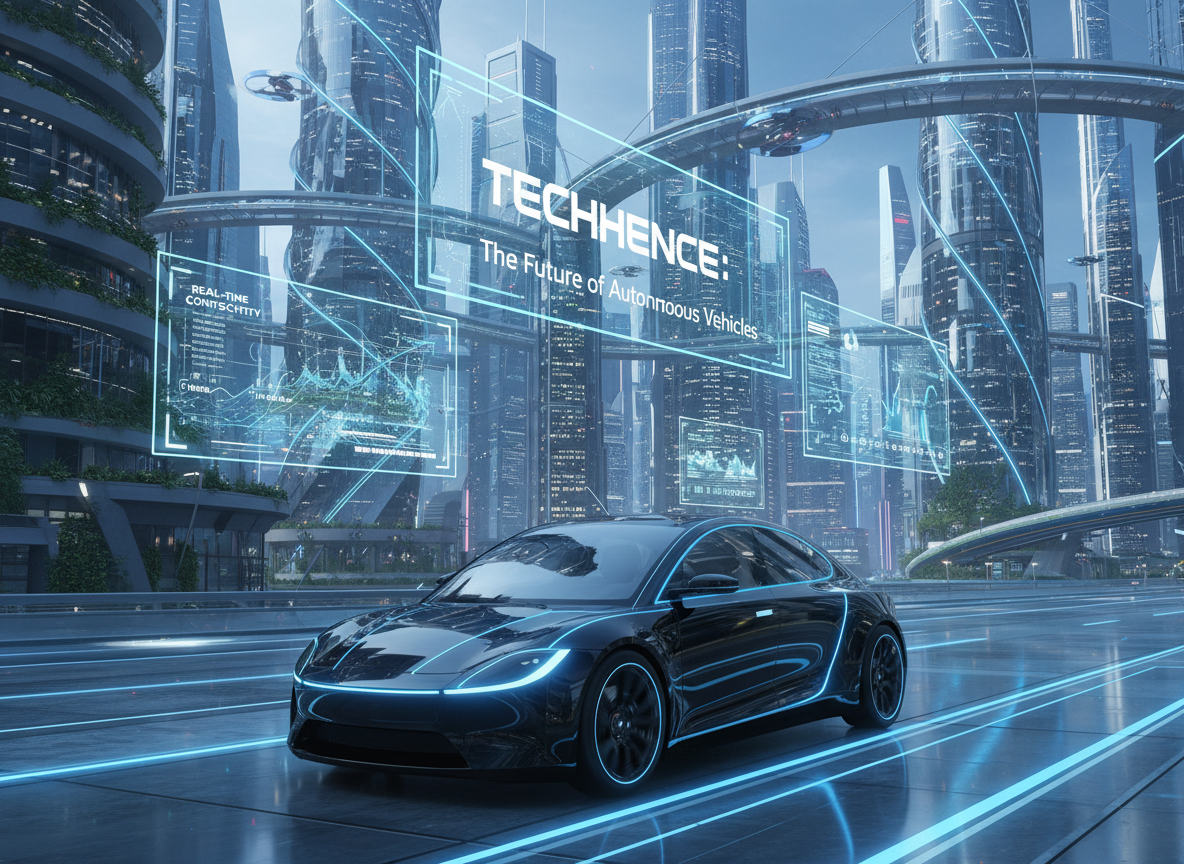
Imagine a morning commute where you don’t touch the steering wheel. Instead, you sip coffee, review a presentation, or simply watch the scenery blur past while your car navigates rush hour traffic with mathematical precision. This isn’t a scene from a science fiction novel; it is the imminent reality of transportation.
At the forefront of this shift is Techhence, a name increasingly synonymous with the next generation of mobility. While the concept of self-driving cars has floated around for decades, we are finally reaching the tipping point where theory meets pavement. This article explores how Techhence is driving the narrative of autonomous vehicles (AVs), examining the current landscape, the undeniable benefits, the hurdles we still face, and what the road ahead looks like.
The Current State of Autonomy
To understand where Techhence fits, we first need to look at the battlefield of innovation. The race to full autonomy is not a solo sprint; it is a complex marathon involving legacy automakers, agile tech startups, and massive software conglomerates.
Currently, the industry operates on a scale of autonomy levels, ranging from Level 0 (no automation) to Level 5 (full automation, no steering wheel needed). Most modern vehicles sit comfortably at Level 2, offering features like adaptive cruise control and lane-keeping assistance. The jump to Level 3, where the car takes over in specific conditions but the driver must remain ready to intervene, is the current frontier.
Key players are investing billions into LiDAR sensors, advanced cameras, and the artificial intelligence required to process terabytes of data in real-time. We see test fleets in cities like San Francisco and Phoenix, navigating complex urban environments. However, these are controlled experiments. The true test—and where Techhence aims to shine—is scalability and reliability in unpredictable environments.
Innovations Driving Change
The technology powering these vehicles is staggering. It’s not just about “seeing” the road; it’s about understanding it.
- Sensor Fusion: Combining radar, LiDAR, and camera data to create a 360-degree, 3D map of the surroundings.
- V2X Communication: Vehicle-to-Everything technology allows cars to talk to traffic lights, other cars, and infrastructure, predicting hazards before they are visible.
- Deep Learning: AI that learns from millions of miles of driving data to distinguish between a drifting plastic bag and a child running into the street.
The Promise: Why We Need Autonomous Vehicles
Why are we pursuing this technology so aggressively? The answer lies in the profound impact AVs will have on our society. The potential benefits extend far beyond convenience.
Safety First
The most compelling argument for autonomous vehicles is safety. Human error accounts for approximately 94% of serious crashes. Distraction, fatigue, impairment, and poor judgment are uniquely human flaws. An autonomous system doesn’t get tired. It doesn’t check text messages. It doesn’t get road rage. By removing the unpredictable human element, Techhence envisions a future where traffic fatalities are a rarity, not a daily statistic.
Efficiency and Traffic Flow
Humans are terrible at optimizing traffic flow. We brake too hard, accelerate too slowly, and merge inefficiently. A network of connected autonomous vehicles can move as a cohesive unit. This concept, known as “platooning,” allows cars to travel closely together at high speeds, reducing wind resistance and maximizing road capacity. The result is less congestion and shorter commute times for everyone.
Environmental Impact
Efficiency leads directly to sustainability. smoother driving patterns reduce fuel consumption. Furthermore, the AV revolution is inextricably linked with the electric vehicle (EV) revolution. Most autonomous fleets are being built on electric platforms. Techhence promotes an ecosystem where shared autonomous mobility reduces the total number of cars on the road, lowering overall carbon emissions and urban pollution.
The Roadblocks: Challenges to Adoption
Despite the rosy outlook, the path to a fully autonomous future is paved with significant obstacles. Techhence recognizes that technology is only one piece of the puzzle.
Regulatory and Legal Hurdles
Who is responsible when a self-driving car crashes? The manufacturer? The software developer? The passenger? Current laws are built around human drivers. Governments worldwide are struggling to create a legal framework that accommodates AVs without stifling innovation or compromising public safety. Standardizing these regulations across borders is a massive diplomatic and legal undertaking.
Technological Limitations
While AI has made leaps and bounds, “edge cases” remain a problem. An autonomous vehicle might handle a sunny highway perfectly but struggle in a blizzard where lane markers are obscured. Predicting the irrational behavior of human drivers, cyclists, and pedestrians in chaotic urban centers remains a difficult computational challenge. Techhence is focusing heavily on these edge cases, training systems to handle the unpredictable nature of the real world.
Societal Trust
Perhaps the biggest barrier is psychological. People are skeptical. Letting go of the wheel requires a massive leap of faith. High-profile accidents involving test vehicles have shaken public confidence. For widespread adoption, the industry needs to prove not just that AVs are safe, but that they are significantly safer than human drivers. Building this trust will take time and transparency.
Techhence: Bridging the Gap
This is where Techhence distinguishes itself. Rather than just focusing on the hardware, Techhence is addressing the ecosystem as a whole. Their approach involves a few strategic pillars:
- Safety-First Architecture: Techhence emphasizes redundant systems. If a camera fails, radar takes over. If the primary computer glitches, a backup engages instantly. This redundancy is critical for building public trust.
- Collaborative Data Sharing: Instead of hoarding data, Techhence advocates for open standards in safety data. By sharing information about near-misses and edge cases, the entire industry can learn faster, accelerating the safety timeline for everyone.
- Human-Centric Design: The company focuses on the passenger experience. How do you communicate what the car is doing to the passenger to reduce anxiety? Techhence is developing intuitive interfaces that keep passengers informed and comfortable, bridging the psychological gap between driver and rider.
The Future Roadmap
So, what does the future hold? We likely won’t flip a switch and see all cars become autonomous overnight. The transition will be gradual.
We will see specialized applications first. Autonomous long-haul trucking on highways is a near-term reality, reducing logistics costs and improving supply chain reliability. We will see geofenced robotaxis in specific city districts. Eventually, as the technology matures and costs decrease, personal ownership of autonomous vehicles will become viable.
Techhence envisions a future where mobility is a service (MaaS). You might not own a car at all. Instead, you subscribe to a fleet. You summon a vehicle when you need it, and it arrives tailored to your trip—a pod for a solo commute, or a larger lounge-style vehicle for a family trip. This shift could redesign our cities, reclaiming parking lots for green spaces and housing.
Conclusion
The journey toward fully autonomous vehicles is one of the most ambitious engineering challenges of our time. It requires rewriting the rules of the road, advancing artificial intelligence, and fundamentally changing how we view transportation.
Techhence stands at the intersection of these challenges, offering solutions that prioritize safety, collaboration, and human experience. While the road is long and the hurdles are real, the destination—a world with fewer accidents, cleaner air, and more free time—is well worth the drive. As we move forward, keeping an eye on innovators like Techhence will give us the best glimpse of what lies around the next bend.