
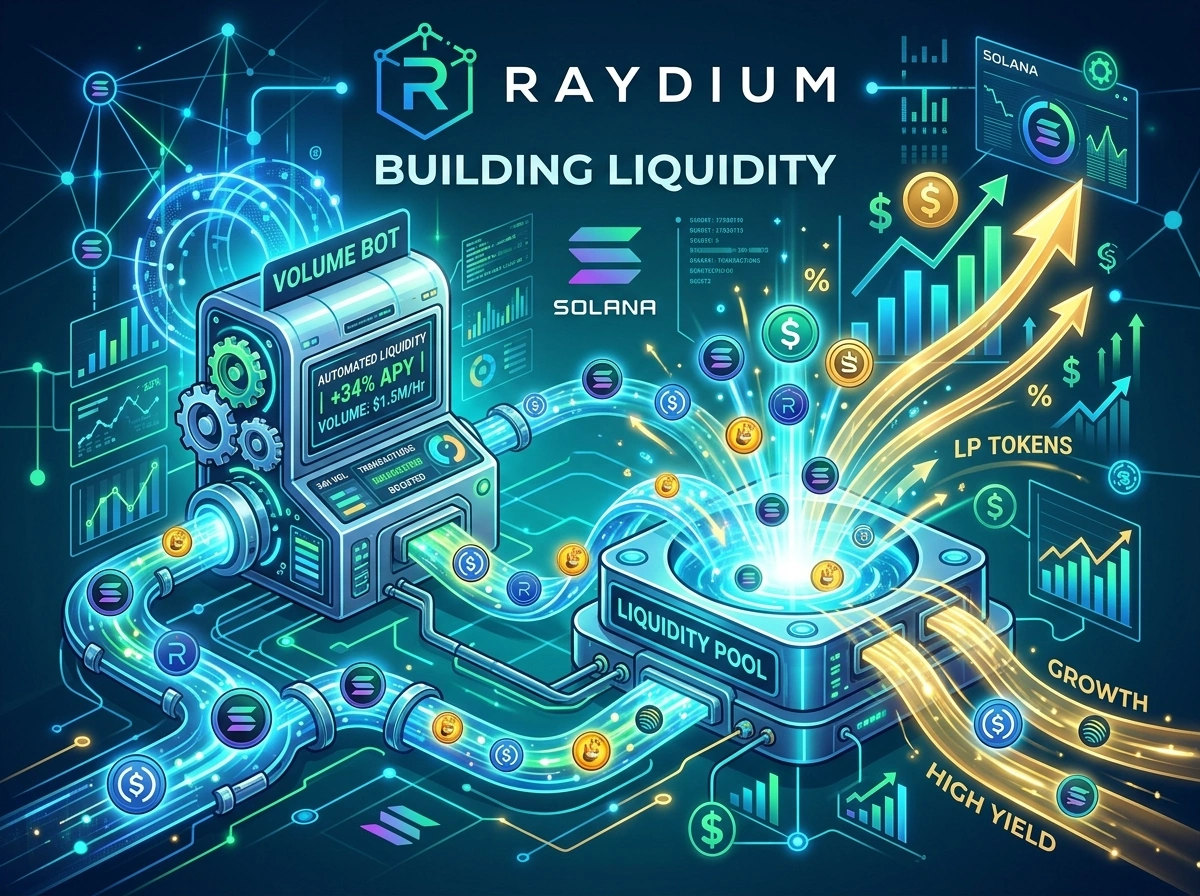
Solana has become one of the most active blockchains for decentralized trading, and Raydium sits at the center of that activity. For projects launching tokens, market participants, and curious newcomers, understanding how liquidity and trading volume function on Raydium is essential before exploring any automation tools. This guide breaks down the fundamentals in plain language, looks at how volume bots are commonly discussed, and offers a balanced view of the benefits, considerations, and risks involved.
What Is Raydium?
Raydium is an automated market maker (AMM) and decentralized exchange (DEX) built on the Solana blockchain. Unlike traditional exchanges that match buyers and sellers through an order book alone, an AMM uses liquidity pools—collections of token pairs deposited by users—to enable instant trading. When you swap one token for another on Raydium, you’re trading against a pool rather than waiting for a counterparty.
What makes Raydium distinctive is its hybrid design. It connects its liquidity to a broader order book system, which historically allowed pooled funds to access wider market depth. Combined with Solana’s fast transaction speeds and low fees, this has helped Raydium grow into one of the busiest DEXs in the ecosystem. For many new Solana-based tokens, Raydium is the first venue where trading begins.
Why Volume and Liquidity Matter on a DEX
Two terms come up constantly in DEX discussions: liquidity and volume. They’re related but distinct, and both shape the trading experience.
Liquidity refers to how much capital sits in a pool. Deeper liquidity means traders can buy or sell larger amounts without dramatically moving the price. Shallow liquidity, by contrast, leads to high slippage—where the price you get differs significantly from the price you expected.
Volume measures how much trading actually occurs over a given period. High volume often signals active interest and can make a token more visible on analytics platforms, trackers, and aggregators that rank or sort tokens by activity.
For project teams, healthy liquidity and steady volume contribute to a smoother trading environment and greater discoverability. Thin, inactive markets tend to discourage participation, creating a difficult cycle to break. This challenge is precisely why automated tools have entered the conversation.
How Volume Bots Are Positioned
A volume bot is an automated program designed to execute trades on a DEX according to preset parameters. In market-making and liquidity-building discussions, these tools are typically positioned as a way to generate consistent on-chain trading activity for a token pair.
Some platforms package these capabilities into broader toolkits. For example, services such as a raydium volume bot are often marketed as part of all-in-one solutions that bundle several functions together for Solana projects.
In principle, the mechanics are straightforward. The bot connects to a wallet, interacts with a specific Raydium pool, and executes buy and sell transactions on a schedule or within defined limits. Proponents suggest this can help a token appear more active, support market-making strategies, and maintain a baseline of on-chain transactions.
It’s important to understand the distinction between organic volume—generated by genuine buyers and sellers—and automated volume, which is produced by a bot trading within a controlled setup. They can look similar on a chart, but they represent very different underlying realities.
Potential Benefits
When discussed honestly, volume bots are framed around a few practical advantages:
- Consistent on-chain activity. Automation can maintain a steady stream of transactions rather than relying on sporadic manual trades.
- Operational efficiency. Bots run continuously without requiring a person to monitor and execute every trade, saving time for small teams.
- Market-making support. Some traders use automated strategies to provide two-sided activity around a pool, which can be part of a wider liquidity approach.
- Configurability. Most tools allow users to set parameters such as trade size, frequency, and timing to match specific goals.
These benefits center on convenience and consistency rather than guaranteed outcomes. No legitimate tool can promise price increases, sustained interest, or trading success.
Operational Considerations
Anyone exploring a volume bot should weigh several practical factors before getting started.
Costs. Every transaction on Solana incurs a network fee. While individual fees are low, a bot running thousands of trades will accumulate meaningful costs over time. There may also be subscription or service fees for the tool itself.
Wallet and key security. Automated tools require access to a wallet to function. Granting that access introduces security responsibilities. Using a dedicated wallet with limited funds, rather than a primary holding wallet, is a common precaution.
Pool selection and settings. The bot’s effectiveness depends heavily on configuration. Poorly chosen parameters can drain capital quickly through fees and slippage without achieving intended results.
Monitoring. “Set and forget” rarely works well in volatile markets. Ongoing oversight helps catch errors, unexpected behavior, or shifting conditions before they cause significant losses.
Risks and Honest Cautions
A credible discussion of volume bots must address the risks directly, because they are real and meaningful.
Artificial activity can mislead. Volume generated by a bot does not reflect genuine demand. Participants who rely on volume figures to judge a token may be misled if that activity is automated. This raises ethical questions and, in some jurisdictions, potential regulatory concerns around market manipulation or wash trading.
No guaranteed results. Automated volume does not create lasting value, attract committed holders, or guarantee price appreciation. Treating a bot as a shortcut to success is a common and costly misunderstanding.
Capital erosion. Continuous trading consumes funds through fees and slippage. Without careful management, a bot can quietly deplete capital while delivering little benefit.
Platform and smart contract risk. Connecting wallets to third-party tools carries inherent risk. Bugs, exploits, or untrustworthy services can lead to loss of funds. Researching any provider thoroughly is essential.
Reputational risk. If a community discovers that a project’s apparent activity was largely automated, trust can erode quickly. Transparency tends to matter more over the long term than short-lived metrics.
Best Practices for a Balanced Approach
If you choose to explore these tools, a measured approach reduces risk and keeps expectations realistic:
- Start with genuine fundamentals. Real liquidity, a clear purpose, and authentic community engagement form a far stronger foundation than automated metrics.
- Understand local rules. Regulations around trading activity vary widely. Research how your jurisdiction treats automated and artificial volume before proceeding.
- Use isolated wallets. Keep automated tools separate from wallets holding significant assets.
- Set strict limits. Define clear budgets and parameters, and monitor results against them.
- Prioritize transparency. Be honest with your community about how you build and support your market.
- Vet every provider. Read reviews, check track records, and avoid services that promise guaranteed outcomes.
Conclusion
Raydium’s role as one of Solana’s busiest decentralized exchanges makes liquidity and volume central topics for anyone active in the ecosystem. Understanding how AMMs work, why depth and activity matter, and how automated tools fit into the picture gives you a clearer foundation for decision-making.
Volume bots occupy a complicated space. They offer convenience and consistency, but they cannot manufacture genuine demand or guarantee success—and they carry real financial, security, and ethical risks. The most durable approach combines honest fundamentals with informed caution. By focusing on transparency, careful configuration, and realistic expectations, you can navigate these tools thoughtfully rather than chasing metrics that may not reflect true value. In the end, lasting liquidity is built on trust and authentic participation, not on numbers alone.