Not all replica watches are created equal. Some are crude imitations that fall apart within weeks, while others are crafted so carefully they can fool even seasoned collectors at first glance. If you spend time around luxury watches, learning to tell these two apart is a skill worth having. It protects your wallet, sharpens your eye, and helps you appreciate the genuine craftsmanship that makes a real Rolex so special.
In this guide, we’ll walk through the exact details that separate a high-quality fake from a cheap knockoff. From the heft in your hand to the tiny engraving inside the rehaut, every clue matters.
Why the Difference Matters
A cheap knockoff is built to look vaguely like a Rolex from across the room. A high-grade replica, on the other hand, is built to survive close inspection. The gap between them comes down to materials, manufacturing tolerances, and attention to detail.
Understanding these differences isn’t just useful for spotting a problem watch. It also trains you to recognize the qualities of an authentic timepiece. For deeper reference material and side-by-side comparisons, resources like Fake Rolex can help you study how different tiers of replicas stack up against genuine models.
Let’s break down the key areas to inspect.
Weight and Build Quality
The first test happens the moment you pick up the watch.
Genuine Rolex watches are made from 904L stainless steel (now branded Oystersteel) or solid precious metals. They feel dense and substantial. A high-quality fake often uses 316L steel, which is close enough to fool most hands. The weight feels right, the finishing is clean, and the case has a reassuring solidity.
A cheap knockoff feels the opposite. It’s light, hollow, and sometimes rattles slightly when you shake it. The metal may look slightly grayish or too shiny, hinting at low-grade alloys or plating. If a watch feels like a toy, it almost certainly is one.
The Movement Inside
The movement is the heart of any watch, and it’s where the real money is spent.
High-Quality Replicas
Better fakes use Swiss or high-grade Japanese automatic movements, often clones of Rolex calibers. They run smoothly and keep reasonable time. Some even feature a sweeping second hand that mimics the genuine 28,800 beats per hour, producing that signature smooth glide.
Cheap Knockoffs
Low-end knockoffs frequently hide a cheap quartz movement or a wobbly, poorly tuned automatic. Look at the second hand. If it ticks once per second instead of sweeping, you’re likely holding a cheap quartz fake. A stuttering or jerky motion is another red flag.
Engravings and Serial Numbers
Rolex is obsessive about precision, and its engravings reflect that.
On a genuine watch, engravings are crisp, deep, and perfectly aligned. Look for the tiny laser-etched crown (the “coronet”) on the crystal at the 6 o’clock position. It’s almost invisible to the naked eye and requires magnification to spot.
High-quality fakes attempt this etching and sometimes get close, though the crown may look slightly fuzzy or off-center. Cheap knockoffs either skip it entirely or stamp it so crudely that it’s obvious under a loupe.
Check the serial and model numbers between the lugs as well. On authentic watches and good replicas, these are clean and even. On cheap fakes, they often appear shallow, sandblasted, or slightly crooked.
Dial Details
The dial is where craftsmanship shows most clearly, and it rewards close study.
Examine the printing on the text and minute markers. Genuine Rolex dials use razor-sharp, perfectly spaced lettering with no bleeding or smudging. High-quality replicas come surprisingly close, with clean fonts and well-applied markers.
Cheap knockoffs reveal themselves through:
- Blurry or uneven text
- Misaligned hour markers
- Lume (glowing material) that looks patchy or fades fast
- Incorrect spacing around the Rolex name
Pay attention to the lume too. Authentic Rolex uses Chromalight, which glows blue and lasts for hours. Many fakes use green-glowing lume that fades quickly, a subtle but telling giveaway.
The Crown and Crown Guard
The winding crown carries the famous Rolex coronet logo, and it’s a favorite weak point for counterfeiters.
On a real Rolex, the crown threads smoothly and seals tightly thanks to the Twinlock or Triplock system. The engraved logo is sharp and well defined. High-quality fakes replicate the screw-down feel reasonably well, though the threading may feel slightly gritty.
Cheap knockoffs often have a loose, wobbly crown with a poorly stamped logo. If the crown doesn’t screw down properly or feels flimsy, that’s a clear warning.
Bezel Inspection
The bezel reveals a lot, especially on sports models like the Submariner or GMT-Master.
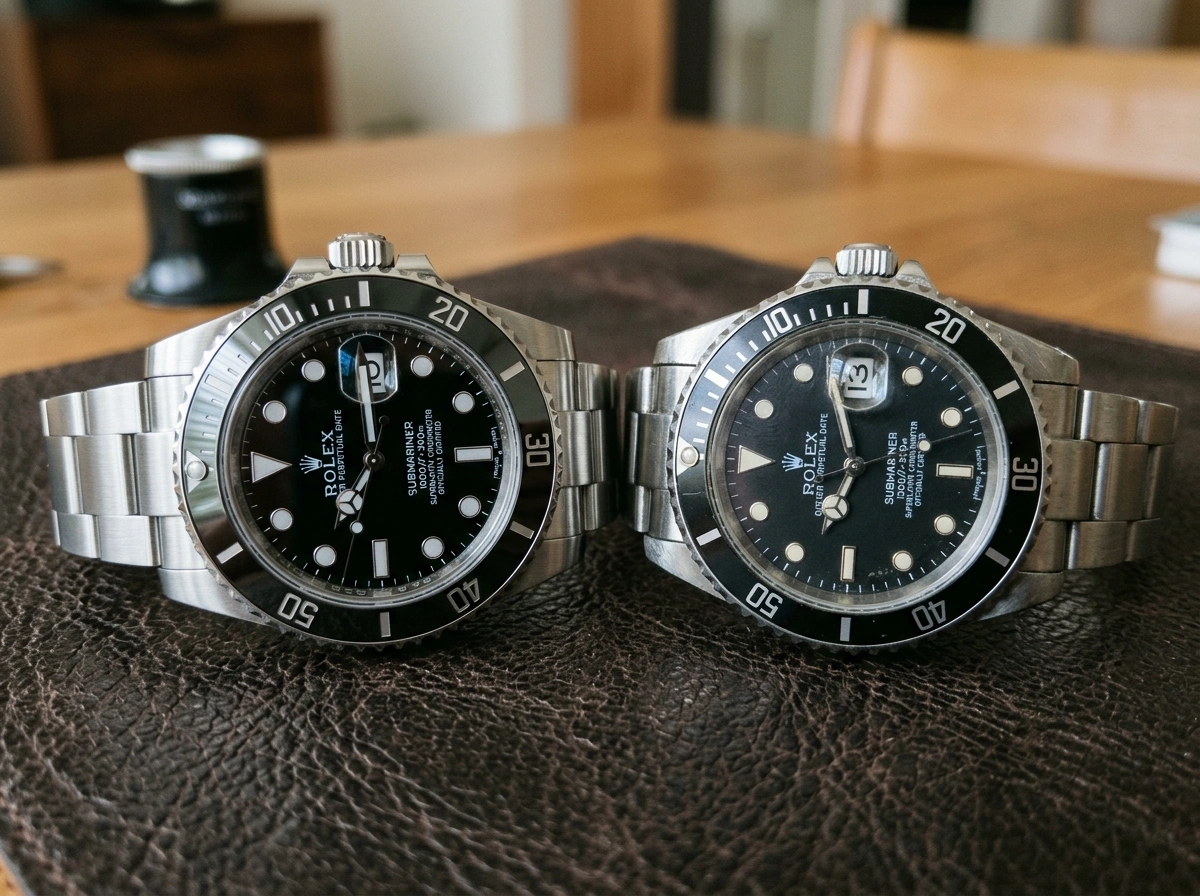
A genuine rotating bezel clicks crisply, with 120 precise stops and no play. The numerals and markers are perfectly aligned, and the ceramic (Cerachrom) inserts have a deep, even color that resists scratches.
High-grade replicas use ceramic bezels with solid clicks that feel close to the real thing. Cheap knockoffs use painted aluminum or plastic, which scratches easily, fades, and rotates with a loose, mushy action. Misaligned bezel markers are another instant tell on a budget fake.
The Cyclops Lens
The small magnifying lens over the date window, known as the Cyclops, is one of the easiest features to check.
On a genuine Rolex, the Cyclops magnifies the date by 2.5 times, making it large and easy to read while filling the entire window. The magnification is strong and clear.
High-quality fakes get close, magnifying the date around 2x. Cheap knockoffs barely magnify at all, often showing a small, hard-to-read date that doesn’t fill the bubble. Hold the watch at an angle and study how much the date enlarges. If it looks weak, the watch is likely a low-grade copy.
Bracelet and Clasp Quality
Finally, inspect the bracelet, which is often where corners get cut.
A genuine Rolex bracelet feels solid, with tight tolerances, smooth links, and zero rattle. The clasp engages with a satisfying, secure click and features clean engravings.
High-quality replicas use solid links and a decent clasp that mimics the real feel. Cheap knockoffs use hollow links that rattle, flimsy clasps that feel loose, and pins that bend or slip out over time. Run your finger along the edges. Sharp, unfinished edges point to poor manufacturing.
Quick Checklist for Spotting the Difference
When you’re examining a watch, run through these points:
- Weight – Does it feel dense and solid, or light and hollow?
- Movement – Smooth sweep or ticking second hand?
- Engravings – Crisp and aligned, or shallow and crooked?
- Dial – Sharp printing and strong lume, or blurry and faded?
- Crown – Smooth screw-down with a sharp logo, or loose and wobbly?
- Bezel – Crisp clicks and ceramic, or mushy and painted?
- Cyclops – Strong 2.5x magnification, or weak and flat?
- Bracelet – Solid links and tight clasp, or rattling and flimsy?
Final Thoughts
Telling a high-quality fake from a cheap knockoff comes down to patience and a trained eye. The cheap copies betray themselves quickly through poor weight, sloppy printing, ticking movements, and loose components. The better replicas demand a closer look, where small flaws in the etching, lume color, or bezel alignment finally give them away.
The more you study these details, the sharper your instincts become. And the real payoff is this: every time you learn to spot a fake, you deepen your appreciation for the genuine craftsmanship that makes an authentic Rolex worth admiring in the first place.